Wind AI
Studies how the wind behaves during the race, and race after race. It offers the crew an optional bold route — a bet on the side of the course that pays — always stated as an option, never as an order.
Like a race engineer on a Formula 1 pit wall, Navigatek talks to your crew while you sail. It reads your sensors, your wind and your position in real time, and turns them into spoken calls you can act on.
Real messages, spoken aloud on board during a race.
Every recommendation comes from a deterministic tool: dual GPS at 10 Hz, onboard wind sensor, polar curves, drift maps learned on your own water. The artificial intelligence computes none of it itself — it reads those results and explains them to you in plain language, during the race or after.
If the data does not exist, Navigatek says so. It never invents a wind, a VMG or a time to the line.
No AI touches the helm, the trim or the call. Navigatek widens what the crew can see and measure, so the decision — which stays yours — rests on facts instead of impressions.
Six specialised systems work together, share the same data and speak the same language — live coaching during the race, structured debrief afterwards. Together they raise the crew's tactical ceiling.

Studies how the wind behaves during the race, and race after race. It offers the crew an optional bold route — a bet on the side of the course that pays — always stated as an option, never as an order.
Speaks out loud on board: live advice through the boat's speaker while you sail. After the race, it answers any question about what happened, in conversation.
Trained on tactical computation: VMG, polars, laylines, and headers. It knows when a shift is worth a tack — and when it is not.
Produces a detailed report of every decision, manoeuvre and condition — so the debrief is structured and built on observable facts rather than memory.
Together the AIs follow everything that happens on the boat — gusts, tacks, speed breakdowns — through the onboard sensor suite. Nothing measurable goes unnoticed.
Reads the scientific literature and the specialist racing press on the web, then commits what matters to memory — so the crew can be given genuine expert advice. It issues a daily briefing and contributes to the post-race reports.
The set of AIs learns, finds its own mistakes and corrects them at every training cycle on the water and after every race. What was wrong last Sunday is measured, named and fixed.
250+ adjustable parameters, used to refine the AI models and improve what they deliver.
The AIs share one sensor suite and follow every action on board, second by second.
Below: the opening of a real report, generated automatically after a race on Lac Tremblant. Nothing was rewritten for this website — the scores and the numbers are those of that day.
Race report — 30 August 2026 · Lac Tremblant · CAN157 · 44.2 min · wind 9.2 kt from 290.3°
Race of 30 August 2026 (44.2 min) in a westerly reaching wind (TWD ≈ 290°, mean TWS 9.17 kt, trend –13.4°). The start cost 14.5 s of delay (21.2 s late crossing). Upwind, mean TWA 51.4°, SOG 4.83 kt, 88.5 % of polar, mean heel 14.9°. Downwind, TWA 150.7°, SOG 5.46 kt, 95.0 % of polar, mean heel 2.6°. Six tacks (mean loss 3.6 s) and no gybes, total loss 48.3 s (1.8 % of the time). A speed breakdown at 15:50 caused a 0.65 kt drop over 515 m for 243 s. Fourteen shifts were detected, only one played (rate 7.1 %). The AI coaching flags 52 anomalies across 18 checks, dominated by family B1 (45 cases of impossible TWA angles). One crew error held a 46° header for 347 s without tacking.
Speed breakdown(s) detected — a step in the speed that an average hides:
15:50 upwind: speed falls from 94.8 % to 82 % of polar — 243 s lost (515 m)
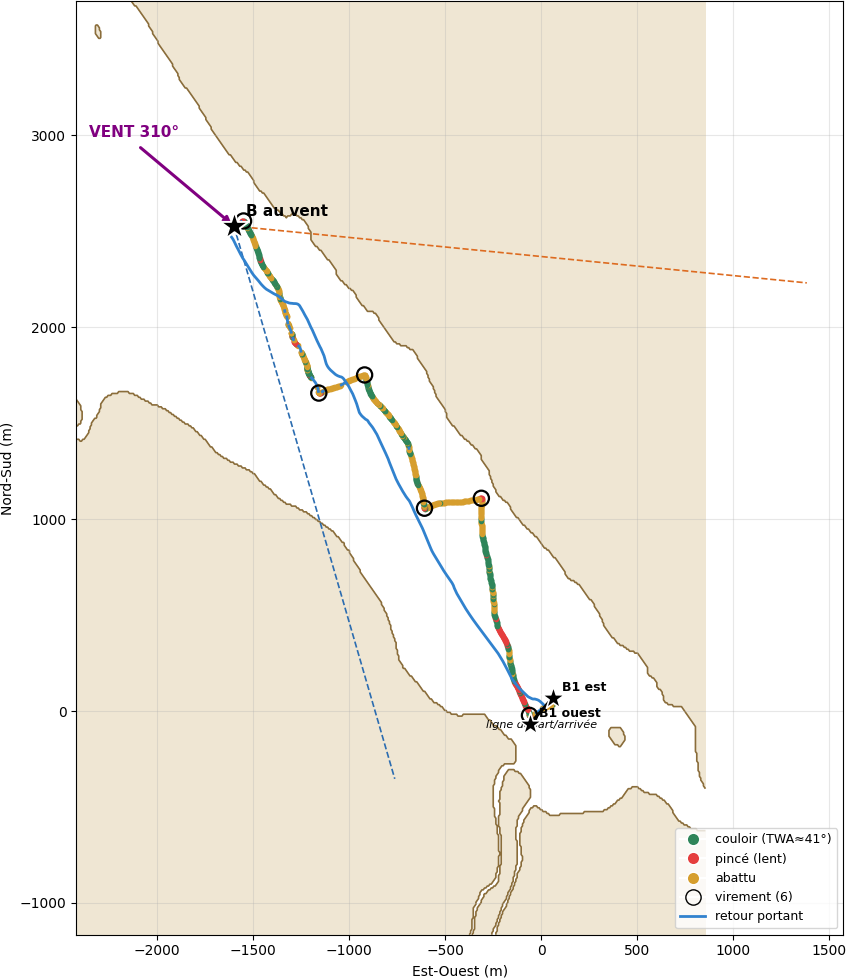
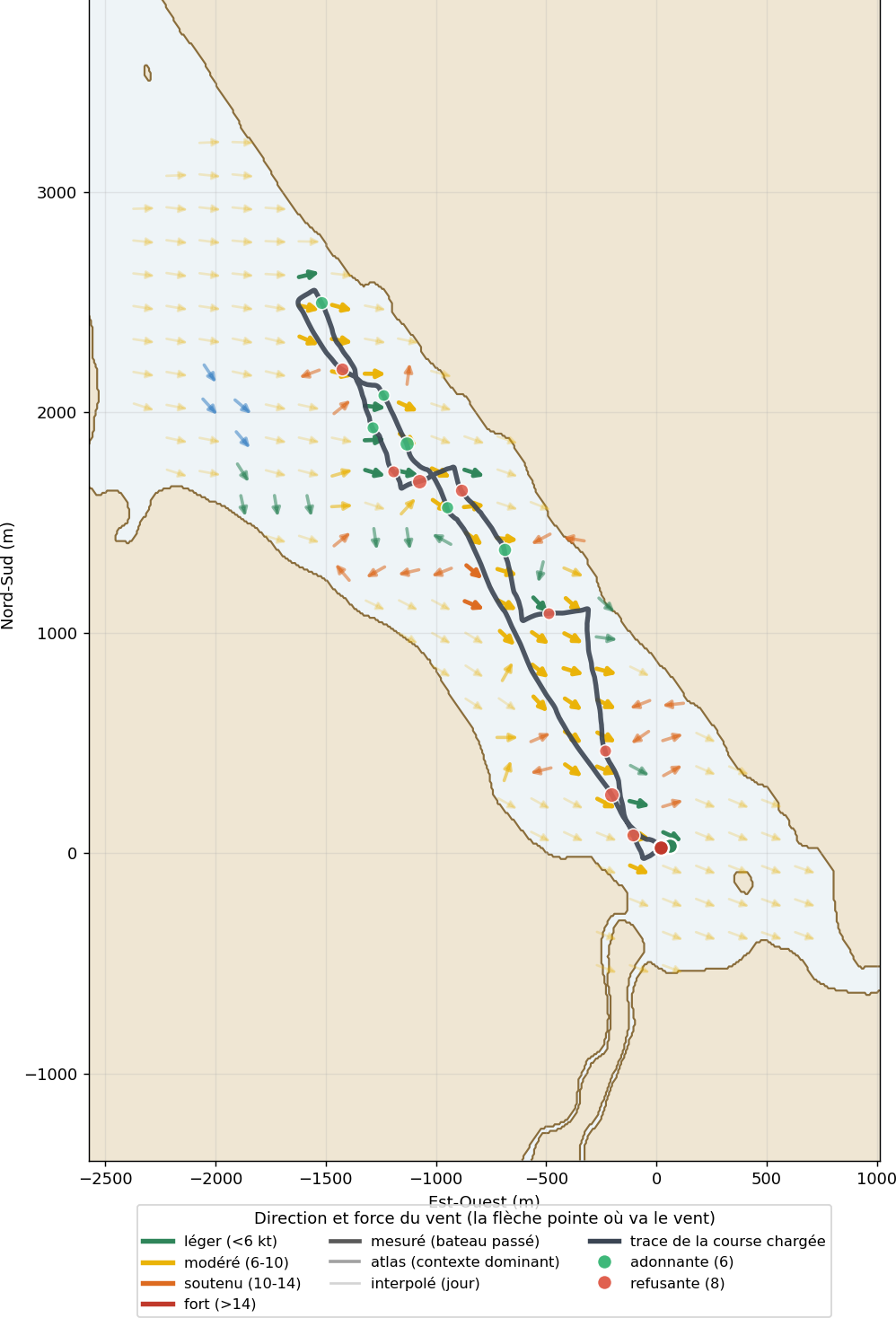
The report runs 12 pages: conditions, start, speed, manoeuvres, wind, tactics, AI-coaching audit, fleet, progression, crew decisions and an action plan.
Navigatek builds specialised race-strategy algorithms, operated by AIs running on dedicated infrastructure — and, ultimately, on the boat itself. No per-token bill, no subscription that grows with every race.
The reasoning is simple: running race operations on cloud AI would be far too expensive, and the network to reach it may simply not be there. A lake, a bay, an offshore leg — coverage is never a promise. So the system has to stand on its own: to cut the cost of a race, and to depend on no network at all.
A rope trailing in the water, weed on the keel — a drag that costs speed the whole leg while the crew looks for the fault everywhere else.
From the plain tack to the harder ones — absorbing a gust without losing the groove — detected, timed and scored against a perfect execution.
Learn how the breeze behaves as the boat moves through it, so a bold tactical plan can be offered — the side that pays, argued with measurements.
Heel, drift, heading, wind — through sensors of every kind, including ones never meant for boats. If a sensor exists and can be useful, Navigatek can read it and put it to work.
Navigatek is not a product for sale. It is a system that exists and already races, together with the expertise that built it — of which you integrate all or part. Three ways to use it.
Professional and amateur teams who build — or commission — their own race tools, and who are looking for deep expertise in the method rather than one more product.
Advanced expertise to fold into your development methods, for the technology you use during a race as much as for the technology used to debrief it.
Your involvement: your technical team and your race data. Expertise is handed over, not rented indefinitely.
Institutions teaching race sailing that want a structured, fact-based debrief without having to build the technical chain themselves.
A complete post-race coaching kit, integrated at your school: sensors, recording and report, ready to serve as teaching material.
Your involvement: your boats and one typical session to calibrate the kit. During the lesson, nothing: the instructor keeps their eyes on the students.
Manufacturers of racing instruments who want to put artificial intelligence into their products, and to know where to start.
Two questions, one answer: how to integrate AI into your products, and which capabilities from this project to take over directly — all of them or some.
Your involvement: your data and your product constraints. The measuring and the proving happen on our side.
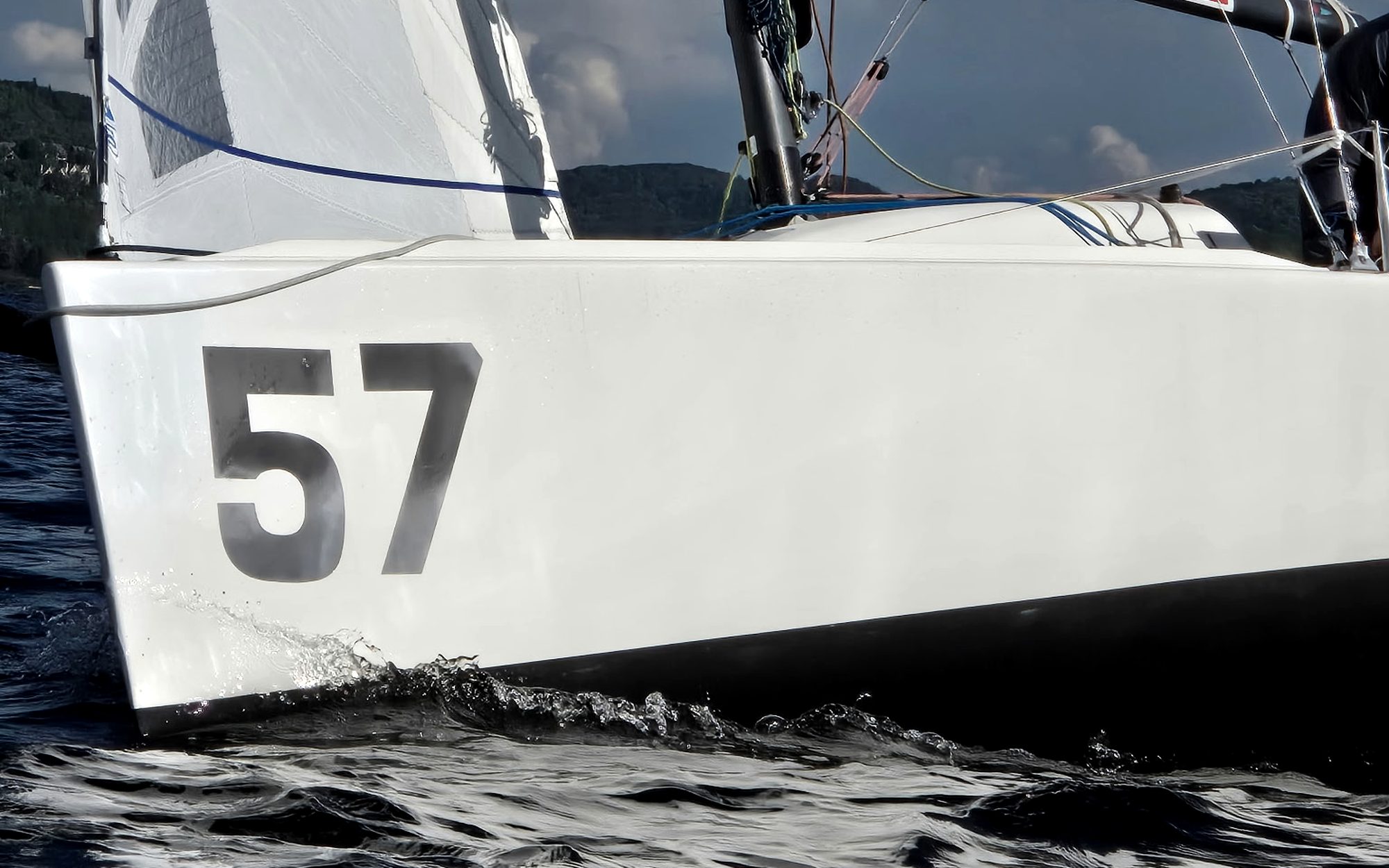
Navigatek was born on Lac Tremblant, aboard a J/70, over a full season of racing. Every function was tested in a real race before it was added to the product — not the other way round.
Yes — with or without network coverage. That independence is a design choice, not a side effect: nothing on board waits for a signal.
Almost anything can work. The products are built from sensors of every type, and the readings go through a normalisation step so that they become compatible with the rest of the system.
It is a high-end solution made for racers, but it serves just as well for learning performance sailing.
Some of the algorithms carry over.
By audio — through a speaker in the cockpit, spoken aloud while you sail.
The system degrades rather than serving something false: it drops back to a source it can still trust, and it says so out loud. A wrong number is worse than a missing one.
No. The AIs run on dedicated infrastructure and, ultimately, on the boat itself — so the cost of a race does not grow with how much you use it.
Yes. Because everything runs on board or on your own infrastructure, your logs, your tracks and your reports stay where you put them.
Every morning, Navigatek reads the sailing press and the blogs, keeps only what a racing crew can actually use, and says why. Each item carries its source link — so you can always go back to the article.
Example — watch of 11 September 2026
Source: Sail-World — sail-world.com
The article covers the third day of the J/70 World Championship in Cascais, with the standings changes and the wind conditions.
What to take from it: On a course closer to shore, and therefore shiftier, a bad start can be made up by working the shifts and the puffs.
For a J/70: Using shifts to regain places applies directly to club racing on a lake like Tremblant, where shore effects are common.
Whether you race, teach or build instruments — if any of this speaks to how you work, write to us. We are happy to go into the detail: what is measured, how it runs on board, and what it would take on your boat.
Contact us for more informationBorn on a J/70. Other classes will follow.