
A real post-race report
This is not a mock-up. Below is the complete report Navigatek produced for race 2 of 12 September 2026 on Lake Tremblant, aboard CAN157 — every figure computed by deterministic tools from the boat's own sensors.
Two things have been changed, and only two: the internal component names have been shortened, and the other boats in the fleet have been renumbered. Nothing else has been touched — not a figure, not a verdict, not a limitation. A report that only showed what went well would be worth nothing.
Race 2 — 15:02:10 → 15:41:01 (38.9 min)
1 · Summary
Speed breakdown at 15:37: 96.3 % of polar for 20 min, then 75.9 % for 4 min WITH NO RECOVERY — that is 1.15 kt and 142 m (65 s) lost. A drop that never repairs itself is not a bad minute: look for a brake (sheet in the water, weed on the keel or rudder, badly tensioned kite) rather than a steering error. 7 anomalies out of 22 checks on the coaching stream, including 148.2 s lost at 15:28:03 to messages queued late. The served wind jumps 42° at every tack: that is a sensor error, not the wind.
Speed breakdown(s) detected — a step measured in the speed, invisible in an average:
- 15:37 upwind: speed falls from 96.3 % to 75.9 % of polar, that is 65 s lost (142 m)
2 · Context and conditions
Sensor health
| sensor | state | valid frames | readings | gaps |
|---|---|---|---|---|
| forward GPS | ok | 100 % | 34007 | 25 >0.3 s |
| aft GPS | absent | 0 % | 0 | n/d |
| Calypso wind | ok | 100 % | 1573 | 0 >4.5 s |
| compass | ok | 100 % | 2324 | 0 >3 s |
| gyroscope | ok | 100 % | 2324 | 0 >3 s |
| barometer | forecast (weather) — no local measurement | 100 % | 232 | 0 >30 s |
| speaker | ok | 100 % | 209 | n/d >3 s |
· aft GPS sensor: no data over the race
3 · Start
· start measured from the race committee's GUN (start 2 gun of Race 2026-09-12 14:51), -53 s relative to the race boundary
4 · Speed and polars
An angle followed by a * is MEASURED (speed triangle, from the apparent wind): the reference wind gave a geometrically impossible one on this leg.
Leg detail — absolute and target speed
| leg | duration | TWA | wind | Mean SOG | Max SOG | polar target | % polar |
|---|---|---|---|---|---|---|---|
| downwind port | 692.7 s | 153.9° | 11.4 kt | 6.5 kt | 9.6 kt | 6 kt | 106.9 % |
| downwind starboard | 99.1 s | 177.8° | 10.3 kt | 5.5 kt | 6.4 kt | 5 kt | 111.7 % |
| reaching port | 170.8 s | 121.7°* | 11 kt | 5.6 kt | 6.3 kt | 7.3 kt | 76.8 % |
| upwind starboard | 702.4 s | 43.6°* | 10.9 kt | 5.4 kt | 6 kt | 5.8 kt | 92.4 % |
| upwind port | 134.1 s | 41.2°* | 10.9 kt | 5.3 kt | 5.8 kt | 5.7 kt | 93.7 % |
| upwind starboard | 75.9 s | 45.7°* | 11.4 kt | 5.4 kt | 6.1 kt | 6 kt | 90.1 % |
| upwind port | 54.5 s | 37.7° | 11.7 kt | 4.8 kt | 5.3 kt | 5.8 kt | 84.1 % |
| upwind port | 122.6 s | 44.9°* | 11.2 kt | 5.1 kt | 6.2 kt | 6 kt | 85.6 % |
| upwind starboard | 154.1 s | 55.2°* | 9.6 kt | 4.8 kt | 5.7 kt | 6.1 kt | 78.7 % |
| upwind port | 105.1 s | 57.4°* | 9.5 kt | 3.3 kt | 4.5 kt | 6.1 kt | 54.2 % |
Tack asymmetry
| point of sail / tack | % polar | n legs | std dev |
|---|---|---|---|
| upwind_starboard | 87.1 % | 3 | 6.0 |
| upwind_port | 79.4 % | 4 | 15.0 |
| downwind_starboard | 111.7 % | 1 | n/d |
| downwind_port | 106.9 % | 1 | n/d |
upwind_delta_starboard_minus_port: 7.7 pts
downwind_delta_starboard_minus_port: 4.8 pts
· polar percentage is computed on SOG (speed over ground): the boat has no paddle wheel, leeway and current are not removed
What the engine gives as a reason, branch by branch:
5 · Manoeuvres
rotation time: median 3 s · from 2 s to 8 s · timed on 5 manoeuvres out of 10
1 announced — a trend seen, not enough to bet on
tack: mean loss 23 s · worst 27 s · best 21 s (n=3) — rotation 3 s (2–8 s, n=4)
gybe: mean loss 28.2 s · worst 28.2 s · best 28.2 s (n=1) — rotation 5 s (5–5 s, n=1)
| time | type | wind | rotation | loss | extent |
|---|---|---|---|---|---|
| 15:02:30 | gybe | 9.6 kt | not measured | 28.2 s | |
| 15:15:42 | gybe | 9.3 kt | 5 s | n/d | |
| 15:17:23 | gybe | n/d | not measured | 0.3 s | |
| 15:18:32 | tack | 10.4 kt | unstable heading | 22 s | |
| 15:30:15 | tack | 12.4 kt | 3 s | 28.1 s | |
| 15:32:29 | tack | 11.4 kt | not measured | 21 s | |
| 15:33:45 | tack | 10.5 kt | 2 s | n/d | |
| 15:34:40 | tack | 12 kt | 3 s | 21 s | |
| 15:36:42 | tack | 9.3 kt | unstable heading | 27 s | |
| 15:39:17 | tack | 9.3 kt | 8 s | n/d |
Point-of-sail transitions — 0 s not counted
Rotation below the threshold of a manoeuvre. Time is lost there all the same, but these are neither tacks nor gybes: they count neither in the total nor in the mean cost.
| time | type | wind | loss | reason |
|---|---|---|---|---|
| 15:14:02 | transition — gybe | 9.8 kt | n/d | cycles where the engine asked to tack or gybe… |
· 1 point-of-sail transition(s) (rotation below the 45° threshold) excluded from the manoeuvre counts: 0.0 s are lost there, listed separately
· 3 loss(es) set aside from the averages: timed from an instant when the manoeuvre had not begun (gap of 71 s, 24 s, 39 s)
· 6 manoeuvre(s) not assessable (wind < 3.0 kt or loss not measured)
5bis · Leeway and symmetries
Starboard: median 7.1° · mean 9.2° · p10 -2.4° / p90 24.6° (n=1165)
Port: median -4.8° · mean -5.3° · p10 -11.1° / p90 0.8° (n=1150)
True leeway 5.9° — compass offset 1.1° (expected range 3° to 6°)
Heel: starboard -11.5° · port 4.1° → true heel 7.8°, sensor offset -3.7°
Upwind: median absolute leeway 8.8° (n=1135)
Reaching: median absolute leeway 4° (n=215)
Downwind: median absolute leeway 4.6° (n=774)
over 52 comparisons FROM THIS RACE only (resets every outing) — the trial setting stayed at 0 for the whole race, this changed nothing in what was served
5ter · The track on the lake
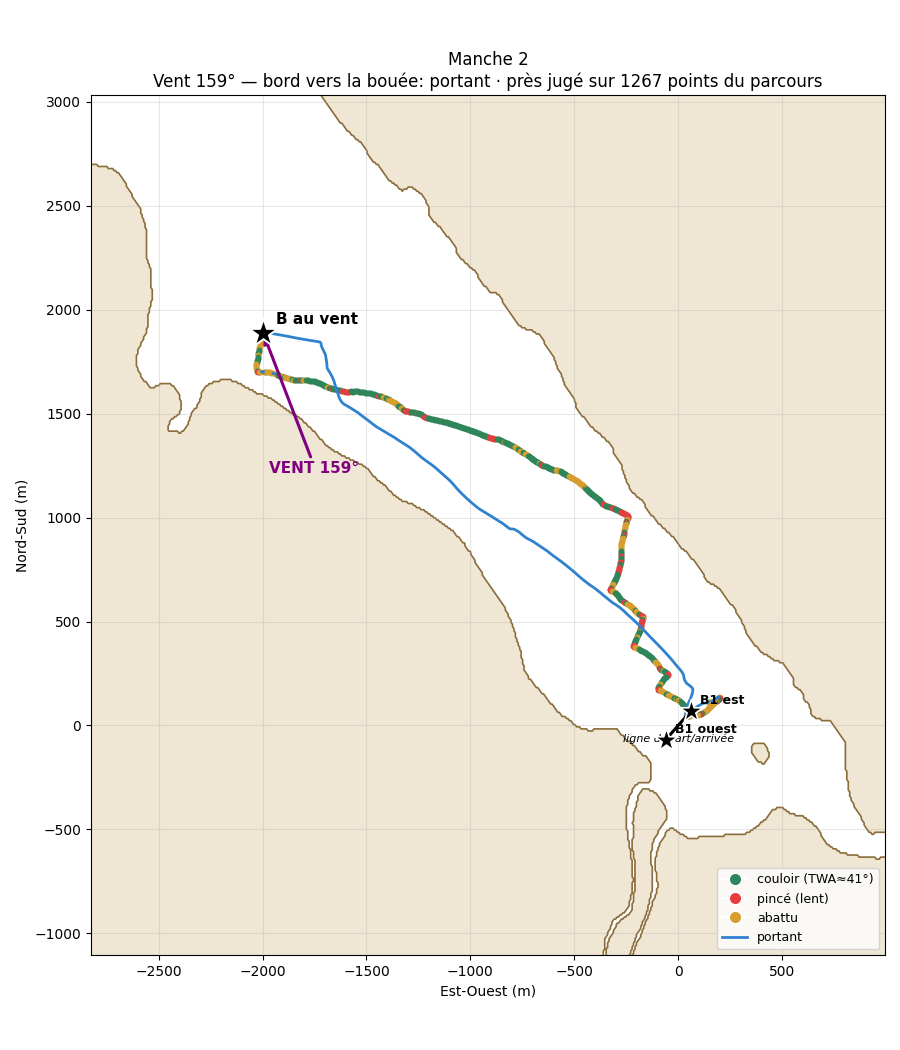
Generated 2026-09-14 08:37 · figures produced by deterministic tools, JSON per race in
6 · Upwind and downwind — angles, speeds, heel
UPWIND
On the water, the coaching stayed SILENT on this leg: its dead band is 6° (anti-chatter), the report judges at 3°. Both are right — the gap costs VMG without deserving to be spoken about during a race.
Time spent by heel band
| heel | % of time | distribution |
|---|---|---|
| 0-5° | 16.8 % | |
| 5-10° | 20.6 % | |
| 10-15° | 23.6 % | |
| 15-20° | 18 % | |
| 20-25° | 13.3 % | |
| 25+° | 7.7 % |
By tack
| tack | legs | TWA | SOG | % polar | heel |
|---|---|---|---|---|---|
| starboard | 3 | 48.2° | 5.2 kt | 87.1 % | 12.1° |
| port | 4 | 45.3° | 4.6 kt | 79.3 % | 13.3° |
DOWNWIND
Time spent by heel band
| heel | % of time | distribution |
|---|---|---|
| 0-5° | 80.1 % | |
| 5-10° | 17.8 % | |
| 10-15° | 1.7 % | |
| 15-20° | 0.4 % |
By tack
| tack | legs | TWA | SOG | % polar | heel |
|---|---|---|---|---|---|
| starboard | 2 | 176.2° | 4.7 kt | 102 % | 2° |
| port | 1 | 153.9° | 6.5 kt | 106.9 % | 3.2° |
· SUSPECT ANGLES: 5 leg(s) publish a TWA LOWER than the measured apparent angle (e.g. 15:18:33: TWA 31.2° for an AWA of 39.5°). Upwind this is geometrically impossible — the apparent wind draws forward. The reference wind is wrong, not the steering: do not judge pointing on this race.
· 6 upwind legs out of 7 carry a MEASURED angle (speed triangle, from the apparent wind) rather than one computed against the race wind: that one gave a value below the apparent, therefore geometrically impossible. These angles are marked with a * in the tables. They do not compare with the tacking angle — the measured angle does not close up when you tack on a header.
· Once upwind, two consecutive legs are on the SAME tack (port): NO tack separates them — the heading turned without changing tack (a luff or a bear-away). Tack is taken from the sign of the MEASURED apparent wind, never deduced from the true wind.
· 1 tack(s) out of 5 taken on a LIFT: the angle turned there exceeds 2×TWA, so the wind had shifted in your favour and tacking gave it back. Example: 15:36:43, 124° turned for -31° of shift.
Our timing and the race committee's DISAGREE: 2384 s against 2196.3 s, that is
· 1 reaching leg out of 1 carries a MEASURED angle (speed triangle, from the apparent wind) rather than one computed against the race wind: that one gave a value below the apparent, therefore geometrically impossible. These angles are marked with a * in the tables. They do not compare with the tacking angle — the measured angle does not close up when you tack on a header.
· 1 downwind leg out of 3 carries a MEASURED angle (speed triangle, from the apparent wind) rather than one computed against the race wind: that one gave a value below the apparent, therefore geometrically impossible. These angles are marked with a * in the tables. They do not compare with the tacking angle — the measured angle does not close up when you tack on a header.
· SPEED BREAKDOWN upwind around 15:37: 96.3 % of polar for 20 min, then 75.9 % for 4 min WITH NO RECOVERY — that is 1.15 kt and 142 m (65 s) lost. A drop that never repairs itself is not a bad minute: look for a brake (sheet in the water, weed on the keel or rudder, badly tensioned kite) rather than a steering error.
7 · The wind — shifts, headers and lifts
The wind swept 50° to drift only -0° from start to finish: it oscillated, it did not turn. In that regime the gain is in tacking on the headers, not in choosing a side.
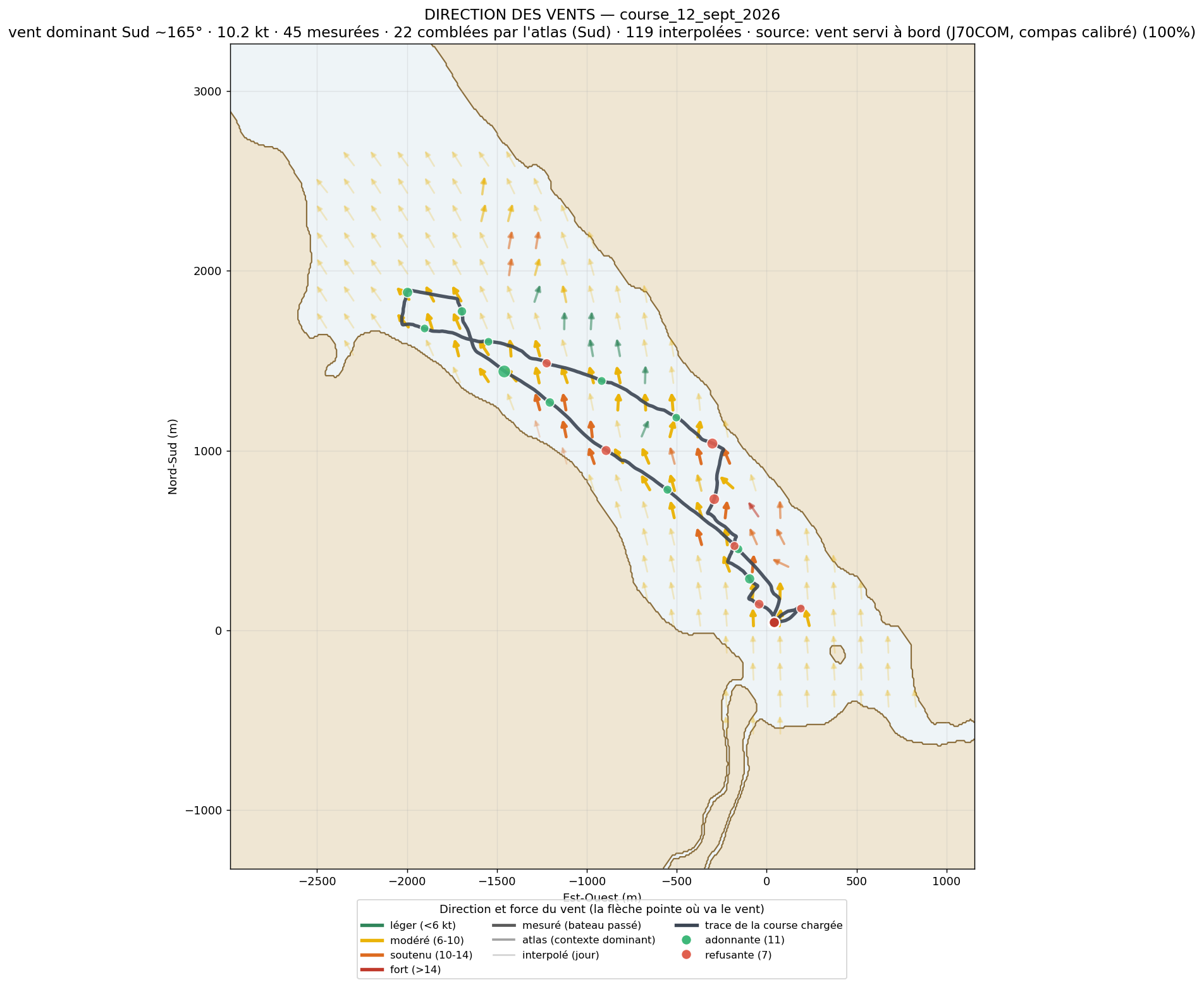
prevailing wind 165° (South) · 10.2 kt · 45 cells measured, 22 filled from the atlas, 119 interpolated · source: wind served on board (the boat's sensors, calibrated compass)
The shifts, one by one
| time | rotation | direction | tack | nature |
|---|---|---|---|---|
| 15:04:50 | -6.4° | left | port | lift |
| 15:07:20 | -6° | left | port | lift |
| 15:09:30 | 8.6° | right | port | header |
| 15:11:20 | -7.2° | left | port | lift |
| 15:12:50 | -16.5° | left | port | lift |
| 15:15:20 | 7.1° | right | starboard | lift |
| 15:17:30 | -9.5° | left | port | lift |
| 15:19:20 | 5.4° | right | starboard | lift |
| 15:21:30 | 5.3° | right | starboard | lift |
| 15:23:40 | -6.7° | left | starboard | header |
| 15:25:30 | 5.7° | right | starboard | lift |
| 15:28:20 | 5.2° | right | starboard | lift |
| 15:29:50 | -11.1° | left | starboard | header |
| 15:32:00 | 10.3° | right | port | header |
| 15:34:10 | -6.2° | left | starboard | header |
| 15:35:40 | 9.2° | right | starboard | lift |
| 15:37:10 | -7.8° | left | starboard | header |
| 15:39:20 | 5.2° | right | port | header |
8 · Tactics
Plan B — the bet on the racecourse
When the module stays silent, why:
- not enough observations: 20
- rotation >= 5 deg over a 60 s window of the served wind
- other: 11
- 0 % of observed cycles — the rest is deliberate sil…
- gain too small or side not yet stable: 3
Observed fault — to follow for improving the AI coaching
The wind module's safeguard serves SIMPLE PERSISTENCE, not the wind model: over 200 comparisons accumulated since 22 August 2026, the model beats persistence only 0.0 % of the time — DOWN since the safeguard was deployed (26.9 % on 22 August 2026). A signal to follow for improving the AI coaching — see the workbook, « wind-model-regressing-vs-persistence ».
high « signal » = what the module saw at every coaching cycle (~40 s), including its silence; « announced » = what actually reached the skipper, after the anti-repeat delay. A call that never leaves the signal is not a fault: it is the module's normal mode (silent by default, see the « water » module). `coverage_reliability` qualifies the NUMBER OF CYCLES OBSERVED, not the quality of the calls themselves: a day without a single call remains a reliable measurement if the module ran on every cycle.
Plan C — the measured header
Why the signal fires:
- Collapsed or negative VMG (haemorrhage): 2
high « signal » = every coaching cycle (~40 s) where the boat is upwind (the tactical engine runs); « announced » = the orders actually spoken, prefixed « Plan C » (see the internal documentation). Critical alerts (collapsed or negative VMG) skip the orchestrator's usual confirmation — that is deliberate, a haemorrhage cannot wait. `coverage_reliability` qualifies the NUMBER OF UPWIND CYCLES OBSERVED, not the frequency of the orders.
Where the « now » orders come from
unstable heading around the manoeuvre (spread 30° > 25°)
- 10 (90.9 %) — the other tack reaches the mark sooner
- 1 (9.1 %) — safety — not enough clear water ahead
Clear water left on these shore orders: 110 m. A shore order is not a tactical choice, it is safety — it is not judged on gain.
· closed course (start ≈ finish): route overcost cannot be computed on net distance
· « exploited » = a manoeuvre within 60 s; the DIRECTION of the shift and the starting tack are not yet taken into account — a low rate does not mean as many missed opportunities
· shift threshold 5° on wind smoothed over 60 s: at Tremblant the water's own oscillation is of the same order
9 · AI coaching audit
other 41 · speed_course 44 · shift 18 · manoeuvre 7 · gust 11 · plan_b 1
Detectable shifts not announced
| time | extent |
|---|---|
| 15:02:10 | 9.4° |
| 15:03:10 | -7° |
| 15:04:10 | -14.2° |
| 15:23:10 | -5.1° |
| 15:24:10 | 9.8° |
| 15:25:10 | 11.6° |
| 15:31:10 | 26.3° |
| 15:32:10 | 8.2° |
| 15:34:10 | 14° |
| 15:36:10 | -11.6° |
| 15:37:10 | -5.8° |
Stream audit — 22 automatic checks
| code | what it means | n | cost | where to look |
|---|---|---|---|---|
| C7 | The voice queue backs up — a message waits for the previous one to end | 1 | 148 s | Orchestrator — announcement cadence |
| C8 | A manoeuvre order leaves by the channel that does not jump the queue | 2 | 16 s | Orchestrator — voice queue |
| C3 | A steering instruction while the boat is crossing the wind | 2 | 6 s | Orchestrator — turn guard |
| D2 | terrain and wind shift confounded (single leg): 9 | 1 | 5 s | boat sensors — manoeuvre detector |
| A3 | not timed: 5 × unstable heading during the rotation | 1 | 2 s | Orchestrator — anti-repeat |
what the coaching BRINGS (shift accuracy) minus what it COSTS in attention (duplicates).
3 lower-cost anomaly(ies) counted but not detailed here — they all appear in the audit document.
The COMPLETE list, with the time and file of every anomaly, is sent from the on-board interface via the « AI coaching » button.
· THE SERVED WIND JUMPS 42° AT EVERY TACK (7 tacks measured). Wind does not turn 42° in ten seconds: this is an error that changes sign with the tack, so the compass or the vane. Any shift announced just after a tack describes this fault, not the wind — and that is what explains so low an accuracy rate. A gap measured from one tack to the other is NOT a shift.
· STREAM AUDIT: 7 anomalies out of 22 checks, 136 cycles examined. The costliest: C7 15:28:03 19 message(s) out of 88 leave the queue late (worst estimated: 16 s) · C8 15:15:18 1 manoeuvre order sent from a non-priority channel (cycle) — · C8 15:32:35 2 order(s) spoken TWICE in the same second by two channels (Plan C
10 · Fleet
| Rank | Boat | Time | Gap to 1st | Start gp. | Status |
|---|---|---|---|---|---|
| 1 | CAN101 | 36:21.7 | +0 s | 2 | FIN |
| 2 | CAN157 | 36:36.3 | +14 s | 2 | FIN |
| 3 | CAN102 | 37:36.3 | +74 s | 2 | FIN |
| 4 | CAN103 | 38:26.4 | +124 s | 2 | FIN |
| 5 | CAN104 | 41:52.6 | +331 s | 1 | FIN |
Source: the race committee · race « Race 2026-09-12 14:51 ».
Checks PASSED — nothing to report: A1, A2, A4, A5, B1, B2, B4, B5, B6, C1, C2, C4, D3, D4, D5 +187.7 s (threshold 3 s). method
11 · Progress
Over the last 10 races analysed.
| Indicator | First | Latest | Gap | Per race | Trend |
|---|---|---|---|---|---|
| Start — seconds lost | 9.1 s | 4.7 s | -4.4 s | -0.662 s | ▼ progress |
| Mean cost of a tack | 6.8 s | 23.0 s | +16.2 s | +1.508 s | ▲ decline |
| Speed — % of polar | 96.8 % | 93.2 % | -3.6 % ≠ | +0.468 % | ▲ progress |
| Coaching — accuracy rate | 20.0 % | 18.8 % | -1.2 % | -0.217 % | ▼ decline |
Not yet enough points for: Tactical overcost.
11bis · The leg close up
Segmentation at 20 m : 308 segments of 6 s median · 140 upwind, 113 downwind
Wind: median of the segments 164.5° · amplitude 61.7° over the race
Upwind VMG: median 4.2 kt · p10 3.4 kt / p90 4.7 kt · spread 0.6 kt
Downwind VMG: median 4.6 kt · p10 3.9 kt / p90 5.5 kt · spread 0.6 kt rate of descent
Downwind, the weakest quarter (28 segments): VMG 4 kt at 128.2° of TWA for 6.3 kt.
The weakest quarter (35 segments): VMG 3.5 kt at 46.5° of TWA for 5.1 kt — this is where time is lost.
12 · Crew decisions
Two measurements of the same upwind: 46.5° as a mean over legs (section 6) against 42.2° as a median over 20 m segments. The 4.3° gap comes from the segmentation: a few long legs weigh as much as hundreds of short segments. The pointing verdict is delivered once only, in section 6.
Median upwind TWA 42.2° for a target of 42° (0.2°) · spread 8° (n=478)
Gust response: over 24 gusts upwind (base wind 10.8 kt), heel gains 5.2° more 6.5 s later — peak at 37.4°. definition
TWS is derived from the apparent wind: on zero-delay events, heel may have manufactured the gust rather than suffered it (6 out of 24).
No decision fault recorded on this race.
Not attributable to the crew
34° of header held for 267 s on starboard without tacking — but the coaching did NOT say to tack: this is an opportunity missed by the system, not by the crew
16° of header held for 27 s on starboard without tacking — but the coaching did NOT say to tack: this is an opportunity missed by the system, not by the crew
38° of header held for 43 s on port without tacking — but the coaching did NOT say to tack: this is an opportunity missed by the system, not by the crew
Action plan
· heel above 20° upwind for 21.0 % of the time: beyond 20° a J/70 slides without gaining one data file per race.